 UK Only - Group

 Join WhatsApp
August 4, 2026







Most people who start investing focus almost entirely on picking the right stock, the right fund, or the right app and spend very little time on the decision that actually matters more than any of those choices combined: how money gets split across different types of assets in the first place. That split, stocks versus bonds versus cash versus other assets, is called asset allocation, and decades of institutional research consistently point to it as the single largest driver of a portfolio's long-term returns and volatility, generally estimated to explain around 90% of the variation in outcomes between different investors, far more than individual stock selection or market timing ever does.
This guide covers how to actually build that allocation: the age-based and goal-based starting points professionals use, the real difference between risk tolerance and risk capacity, and how the practical building blocks differ across the US, UK, and Nigeria specifically, since the tools available and the role each asset class plays genuinely change depending on which market someone is investing in.
Every portfolio is ultimately built from a small set of broad asset classes, each playing a different role. Equities, or stocks, are the primary growth component, ownership stakes in businesses offering higher potential long-term returns in exchange for real short-term volatility. Fixed income, bonds, and treasuries function as the defensive counterweight, paying predictable interest while dampening overall portfolio swings. Real estate, whether direct property or a real estate investment trust, tends to serve as a partial inflation hedge alongside steady income. Cash and bond equivalents provide the liquidity buffer, the zero-volatility reserve meant for emergencies and near-term needs rather than growth.
How these building blocks combine depends on two things above all: time horizon and risk tolerance versus risk capacity.
Time horizon is simply how long money can stay invested before it's actually needed; buying a home in three years looks nothing like retiring in twenty-five. A useful way to think about this is sorting goals into short-term needs within about three years, medium-term goals in the three-to-seven-year range, and long-term goals eight years or further out. Short-term money generally has no business sitting in volatile equities regardless of someone's age, since a market downturn arriving right before the money is needed leaves no time to recover.
One of the most common mistakes in this area is treating risk tolerance, the emotional willingness to endure a portfolio dropping sharply without panicking, as the same thing as risk capacity, the structural, financial ability to absorb a loss without disrupting daily life. A simple gut check separates the two: risk tolerance asks whether someone would sell everything if their portfolio dropped 25% overnight; risk capacity asks whether they could still comfortably pay rent and bills if it did.
A 28-year-old with a stable job and decades until retirement has high risk capacity, even if their personal temperament makes them nervous during a downturn. A 62-year-old planning to retire next year has low risk capacity almost by definition, regardless of how calm they feel about market swings, simply because there's little time left to recover before that money is needed. Building an allocation around comfort alone, ignoring capacity, or around capacity alone, ignoring the real behavioral risk of panic selling, both produce allocations that don't hold up when markets actually get difficult.
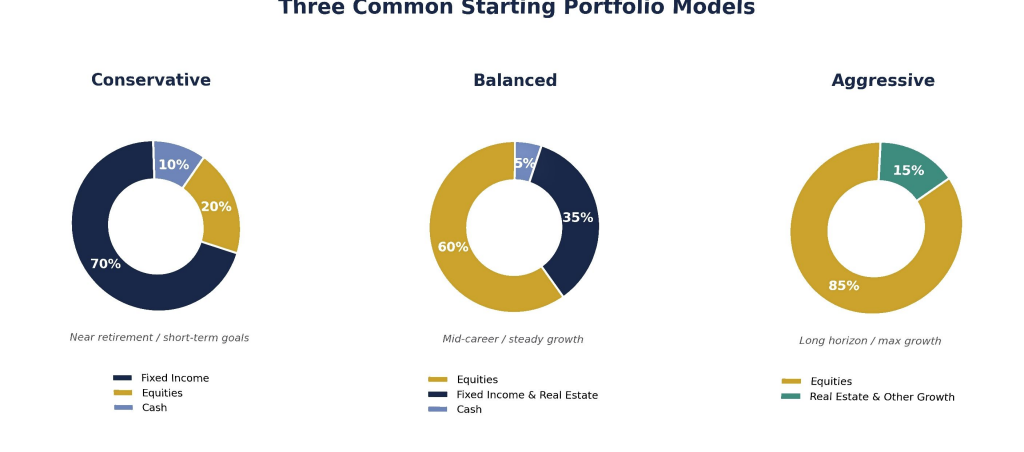
Financial planners commonly describe three broad portfolio archetypes as reasonable starting points, adjusted from there for individual circumstances. A conservative model, roughly 20% equities, 70% fixed income, and 10% cash, suits investors nearing retirement or funding a near-term goal, prioritizing capital preservation over growth. A balanced model, roughly 60% equities, 35% fixed income and real estate, and 5% cash, suits mid-career investors seeking steady growth without extreme swings. An aggressive model, 80% to 90% equities with the remainder in real estate or other growth assets, suits younger investors with a multi-decade horizon who can tolerate sharp short-term losses in exchange for stronger long-term compounding.
The age-based shorthand many people default to, "100 minus your age" equals the percentage in stocks, has largely shifted toward "110 minus age" or even "120 minus age" in practice, reflecting that people now often live 25 to 30 years past retirement and need sustained growth exposure for longer than earlier generations did. Under the 110 version, a 30-year-old would target roughly 80% stocks, a 50-year-old around 60%, and a 70-year-old closer to 40%. These formulas are explicitly starting points, not personalized answers; none of them account for other income sources, specific goals, or genuine risk capacity on their own.
Within the stock portion of a portfolio specifically, diversification matters just as much as the stock-bond split itself. A common guideline suggests allocating roughly 20% to 40% of stock holdings to international markets outside an investor's home country, since foreign markets don't always move in tandem with domestic ones. It's worth noting that owning several funds isn't automatically diversification; multiple global technology funds, for instance, often hold largely the same handful of mega-cap companies, providing far less genuine diversification than their number suggests.
For US investors using a 401(k), IRA, or similar retirement account, target-date funds offer a practical way to implement an age-based allocation without manually rebalancing, automatically shifting from growth-heavy toward conservative as the target retirement year approaches. A simpler alternative some investors use is a two-fund portfolio, a total world stock index fund paired with a total bond market fund, which provides broad global diversification with minimal ongoing maintenance. J.P. Morgan Asset Management's 2026 long-term capital market assumptions project a real return of roughly 6.4% for a standard 60/40 global stock-bond portfolio over the coming decade, a useful benchmark for realistic expectations rather than assuming recent bull-market returns simply continue.
UK investors typically build allocation through a Stocks and Shares ISA or a SIPP, often using risk-rated multi-asset funds that bundle a specific stock-bond mix, cautious, balanced, or adventurous, into a single fund managed on the investor's behalf. These function similarly to US target-date funds in convenience, though the risk labels reflect a fixed allocation profile rather than a specific retirement year, meaning an investor manually moves to a more cautious fund over time rather than the fund adjusting itself automatically.
Nigeria's asset allocation picture looks structurally different from the US and UK, not just in the specific numbers but in what each asset class is actually for. Nigerian equities on the NGX have delivered strong returns in growth years, sometimes 15% to 25%, but carry high volatility and don't offer the same role as a stabilizing anchor that government bonds play in a US or UK portfolio. Nigerian Treasury Bills, yielding roughly 16% to 22% in 2026 and accessible through platforms like i-invest or Cowrywise, function as the more genuinely stable, capital-preservation portion of a naira-based portfolio, closer to what a bond allocation does elsewhere.
The role that international stock diversification plays in a US or UK portfolio is largely played by dollar-denominated assets in a Nigerian one. Eurobonds and dollar-denominated mutual funds, accessible through platforms like Risevest, Bamboo, Trove, and Chaka, commonly yield 7% to 12% in actual dollar terms and function primarily as a hedge against naira depreciation rather than simply a growth play. Nigeria's mutual fund industry has grown rapidly; total assets under management roughly doubled in a recent year to over ₦7.6 trillion, with a specifically strong shift toward fixed-income and dollar-denominated funds, reflecting exactly this kind of currency-hedging behavior at scale. In markets where inflation regularly threatens to outpace naira-denominated returns, some investors also hold a modest allocation, commonly cited around 10% to 20%, in physical real estate or property-backed instruments as an additional inflation hedge tied to real-world assets rather than paper yields alone.
One point matters enormously for diaspora Nigerians specifically: a naira-denominated fund advertising an impressive 20% to 90% return can still represent a real loss once converted back to dollars or pounds if the naira has depreciated by a similar or greater margin over the same period. A fund posting a 60% naira gain provides no real benefit to a dollar earner if the naira has lost 65% of its value against the dollar in that same window. For diaspora investors specifically, the actual, dollar-adjusted return matters far more than the advertised naira figure, which is exactly why dollar-denominated platforms have grown so quickly among this group.
Start by sorting financial goals by time horizon, short, medium, and long-term, since short-term money shouldn't sit in volatile assets regardless of age. Choose a baseline allocation, conservative, balanced, or aggressive, that matches the longest-horizon goal being funded and genuine risk capacity, not just comfort level. Implement that allocation using broad, low-cost index funds or ETFs rather than individual stock picking, which delivers instant diversification across thousands of underlying holdings. Automate contributions on payday to enforce consistency and remove emotion from the process entirely.
An allocation set once and never revisited drifts over time; a portfolio that starts at 70% stocks and 30% bonds can quietly drift to 85/15 after a strong bull run, becoming considerably more aggressive than originally intended right before conditions might turn. Rebalancing, periodically selling a portion of whatever has grown disproportionately and buying more of whatever has lagged, brings the allocation back to target and is one of the few disciplined ways to systematically buy low and sell high rather than chase whatever performed best recently. Calendar rebalancing, checking on a fixed schedule such as once a year, and threshold rebalancing, adjusting only once an asset class drifts a set amount, commonly 5 percentage points, from its target, are both reasonable approaches. Either is better than never rebalancing at all.
Chasing last year's best-performing asset class is one of the most consistent behavioral errors in investing; recent outperformance says very little about future performance and often signals an asset that's become more expensive relative to its fundamentals, not less risky.
Confusing risk tolerance with risk capacity leads either to an overly conservative allocation for someone who can genuinely afford more growth exposure or an overly aggressive one for someone who will be forced to sell at the worst possible time during a downturn.
Mistaking a large number of funds for real diversification is common; several funds that all track the same handful of mega-cap companies provide far less genuine risk reduction than their number suggests.
Ignoring fee drag adds up quietly over decades; a fund charging meaningfully more than a comparable low-cost index alternative, commonly under 0.2% in annual expenses for major index products, erodes returns steadily without ever showing up as a single obvious loss.
Never rebalancing lets a portfolio's actual risk level drift silently away from its intended target over several years, often without the investor realizing how much more aggressive their holdings have become.
Asset allocation is the decision that quietly does more work than any individual stock pick, fund choice, or app selection, and the good news is that it doesn't require predicting markets correctly, only an honest read of time horizon and genuine risk capacity, paired with a diversification strategy appropriate to the specific market being invested in. What counts as the "stable" or "growth" portion of a portfolio looks different in the US, UK, and Nigeria specifically, but the underlying discipline, choosing an allocation deliberately and rebalancing it periodically rather than letting it drift, holds up everywhere.
What's the difference between risk tolerance and risk capacity?
Risk tolerance is the emotional ability to handle market volatility without panic-selling; risk capacity is the actual financial ability to absorb losses given someone's timeline and situation. A young investor with a stable income has high capacity even if they feel nervous during downturns, while someone near retirement has low capacity regardless of how calm they personally feel.
Is the "100 minus age" rule still considered accurate advice?
It's now considered somewhat conservative for most investors, given significantly longer life expectancies. Many current planners favor "110 minus age" or "120 minus age" instead, reflecting the need for sustained growth exposure well into a 25- to 30-year retirement.
Can a complete portfolio really be built with just one or two funds?
Yes. A total world stock index fund paired with a total bond market fund, or a single target-date fund that combines both automatically, can provide genuine global diversification with minimal ongoing effort and is a completely reasonable approach for many investors.
How often should a portfolio actually be rebalanced?
Once or twice a year is a common, reasonable frequency for most individual investors, or whenever an asset class drifts a set amount, often five percentage points, away from its original target, whichever comes first.
Why can a Nigerian mutual fund with a high advertised return still be a bad investment for someone earning in dollars?
Because the advertised return is usually quoted in naira, and if the naira has depreciated significantly against the dollar over the same period, the real, dollar-adjusted return can be flat or negative even when the naira figure looks impressive on its own.
It's tempting to treat investing as a series of individual decisions, which fund, which stock, which app, when the decision that actually shapes long-term outcomes the most happens earlier and more quietly: how money gets divided across asset types in the first place and whether that division genuinely matches someone's timeline and real capacity to withstand a downturn, not just how they feel about risk on a good day.
None of this requires predicting where markets go next. It requires an honest allocation decision made once, implemented through broad, low-cost funds, revisited periodically, and left alone in between, resisting the very human urge to chase whatever performed best last year. That discipline, more than any individual pick, is what tends to separate portfolios that hold up over decades from ones that don't.
Disclaimer: This article is for general informational and educational purposes only and does not constitute financial or investment advice. Asset allocation should be based on individual circumstances, goals, and risk tolerance. Consult a licensed financial advisor for guidance specific to your situation.
Last Modified: 2026-07-25 22:41:49
Alisha Kim, A dedicated publisher at Presoft Solutions, publishes educational and informative content on finance. The goal is to provide readers with reliable, easy-to-understand, and practical information that helps them discover opportunities and make informed decisions.


